

Thanks for Looking at Us: Crónicas de Barrio Celebrates the Corazón of Mexico City
- Vigilance

- May 27
- 12 min read
Updated: May 29
By Karen Moe
Interview with Iván Aguirre

What’s the difference between a colonia and a barrio?
What’s the difference between a barrio and a pueblo? If you live in Mexico City, you may or may not have an answer and, if you do, it may be different from someone else’s. For Mexican director Iván Aguirre, barrios are the neighbourhoods that still exist with all of their unique traditions and communal pride, neighbourhoods that were once pueblos on the outskirts and have become absorbed by the sprawl of the city. Barrios are cultural oasis that resist gentrification by maintaining their essence and Aguirre’s 12-part series, Crónicas de barrio (Tales of the 'Hood), celebrates just that.
Each of the 12 episodes features a different barrio and each episode features five main residents who represent their community through their personal stories. A storyteller since childhood, Aguirre remarked how even though documentary television and film are based on reality, they are never 100% ‘faithful’ to it. Like all creative work (and one could argue perception in general), subjectivity is always involved. From the shots to the editing choices, directorial decisions are what build the resultant representation of a place from the materials found in a community. And this is particularly true in what members of the community and even which barrios are chosen to compose the blend of subjectivity and objectivity that creates a documentary that is, perhaps paradoxically, faithful to the reality of art creation, following the art and, in Aguirre’s words, “learning in community.”

During our interview at Salon Martis in Colonia Escandón, Mexico City,
I asked Aguirre about how, with virtually countless barrios to choose from, he decided on which ones to feature. As a Mexico City resident—or Chilango—he told me how his ‘choices’ were made through his own personal relationship with the city: through people he knew, his life lived in what Mexican writer and philosopher Carlos Monsiváis called the Infinite City. Aguirre explains how:
"There were multiple ways to approach it, but the methodology is actually quite simple. You just have to know one person from the barrio, just one person who’s well-connected and they will lead you to the other people. For most of our shows, we had one person who we call a fixer. They were the one contact that got us all the other contacts."
However, for some of the episodes, based on the intuition of the director and his penchant for adventure that week, he would go in ‘fixer-less.’ Because of his desire to tell the story of a barrio that has a particularly rich history, he would jump in headfirst, so to speak, and trust in serendipity. Aguirre and his Canal Once (Channel 11) crew would literally follow the possibilities alive in art when one is unrestrained and curious about their subject matter. He relates how:
"Sometimes, if we were desperate and had no one, we would just go there and ask people or find them and they would tell you: ‘Oh, you should go to that taco stand on this corner, or you should go to the carpenter who has been here for decades.’ Sometimes people would approach us. It wasn't hard to do. We used to say that this show was very blessed in that sense because we never had problems finding stories and finding characters."
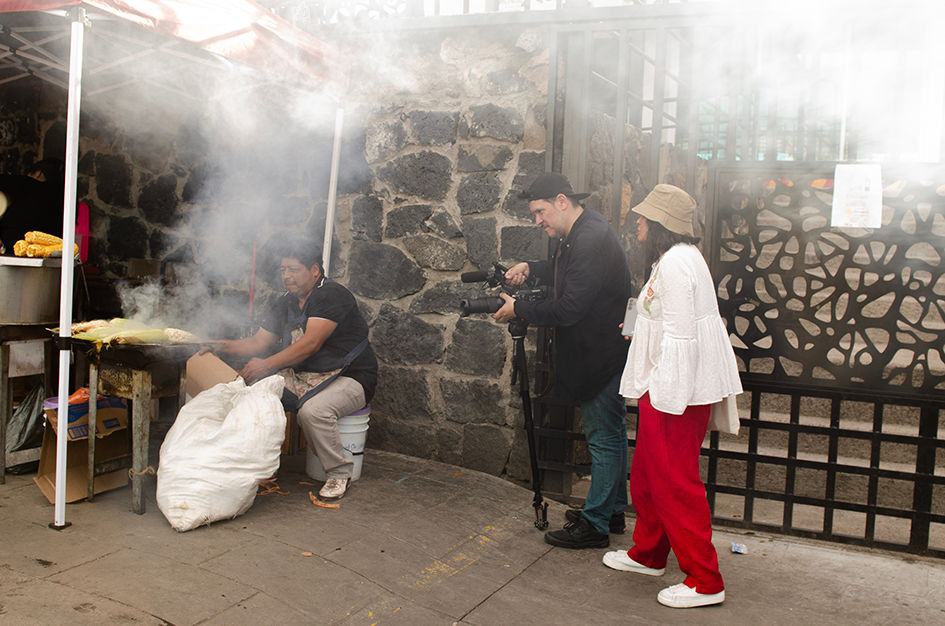
One of the main reasons Aguirre didn’t have any problems finding characters
is because of the nature of public television itself. As soon as residents of the barrios knew they were from Canal Once— the most well-loved public television station in Mexico—they were more than happy and proud to tell their stories. Aquirre comments how, especially for people who grew up in Mexico City, Canal Once’s cultural and educational programming is “imprinted in their hearts and their minds because they loved it so much when they were kids.” This lifetime of trust is completely opposite to the large commercial stations like Televisa and TV Azteca where any authenticity is negated by ratings and profit. Aguirre explains:
"Televisa and TV Azteca never go to the barrios unless there is a horrible story, something about violence, or something that would appear in the news about a shooting. These are the places where we go, places that are full of amazing people who commercial TV stations characterize as dangerous. They want to exploit the community, and everything is sensational, and not a good representation of the diversity of the people. 99% of the people are not criminals. Crónicas de barrio focuses on positives that enrich society. We're highlighting the good stuff."
Because they are unrestrained by ratings and corporate sponsors,
Canal Once is free to do what they want, to tell the stories they want, and to represent communities positively. And, paradoxically, these stories of the barrios, the good stuff, are stories that are rarely, if ever, told. Crónicas de barrio tells marginalized truths—the marginalized truths that compose the majority.
What the lives of the people who live in the often-shunned barrios made possible by public television show is the pride and community spirit that are, paradoxically, worlds that have rarely been revealed to the country and even other Chilangos living in other parts of the infinite city. Canal Once is like the corazón of Mexico City. When it comes to combating endemic prejudice and fear about parts of the city that many do their best to avoid, representing communities as what they really are is akin to a revolution of perception.

In the face of rabid gentrification
with its cultural homogeneity and individualism preying upon Mexico City and any part of the world it can get its teeth into, one of Aguirre’s intentions is finding connections in the communities of the barrios. He tells the stories of the barrios themselves through, as he puts it, “striving to find something that connects everything. Maybe one idea, two ideas, or three ideas that connect everyone, everything in that place, in that neighbourhood, in the barrio.” In the episode “Ajusco Bronx: resistencia en el pedregal” (Ajusco Bronx: Resistance in the Stony Ground), Aguirre not only discovers connections within the barrio itself, but this episode also reveals a largely forgotten foundation for community in the mega-city. Aguirre tells the tale of a history that is literally made of stone:
"In the south of the city, there used to be a civilization that was much older than the Aztecs. We tend to think of Mexico City as the city of the Aztecs because the downtown was built on the ruins of the old Aztec empire. But centuries before that, there was another civilization in what is now the south of Mexico City. That city was destroyed by a volcanic eruption—much like Pompeii in Italy. The remnants of that eruption are an ecosystem that's called a pedregal, like a stone quarry. This one particular barrio was built over those stones. People were working on great construction projects at that time. One of them is the great project of UNAM, Universidad Nacional Autónoma de México [that was built between 1949 and 1952]. The workers who built UNAM didn't have any places to live, so they started building houses over the stones and made the barrio of today, Pedregal Ajusco."

Upon this foundation of three generations
who literally claimed the land outright on which their ancestors continue to live, Aguirre explains how he tells the story of the people who live there right now. However, the ‘now’ is inevitably connected to from where, and from whom, it originated. Aguirre relates how: “When I was interviewing the residents, little by little, I found out that everything is connected to that volcanic eruption hundreds of years before the Aztecs. And then also to the people that went there to work and didn't have any place to stay.” Moreover, this episode tells us how in the 1970s migrants joined the residents of Ajusco—who are from a capitalist perspective a community of ‘squatters’—and fought to enforce their right to housing. The continued foundation of Ajusco is one of marginalized peoples claiming community beyond the strictures of private property and now, as the city is being compartmentalized by condos far out of the price range of the average Mexican, gentrification.

Crónicas de barrio brings community and connection to the forefront
and the barrio Pedregal Ajusco continues the resistance that originated in their ancestors collectively claiming space decades ago. As a continuation of the tradition of community and resistance, the narrator tells us how "Ajusco is home to young artists and entrepreneurs who are inspired by the surroundings and for whom not only resistance, but also creation is something collective."
Iván Ortiz is ‘the fixer’ of this episode; he is a graphic artist and taco maker committed to the culture of urban art in his community. He is one of the founders of the art collective, “Ajusco Bronx,” the Bronx in NYC being a peripheral community the artists felt they could identify with. Like the stone upon which their barrio stands, the artists named themselves “Ajusco Bronx” as, in Aguirre’s words, “a very strong cultural force, but from the periphery.” The group began with graffiti and paste-ups and has now extended into other art forms like ceramics where the members share and develop techniques together. And there are always the stickers, a passion of Mexico City Street Artists: stuck on all available surfaces, each design as graffiti tags in conversation with one another, both design and placement inspired by their environment like their ancestors who, removed from the soullessness of blasting and levelling the land, built their houses according to the shape of the volcanic rock.

Through Iván Ortiz, we meet Mell Hernández, a beatmaker and music producer. He is working on a project about urban artists like jugglers, street theatre groups, and graffiti artists who are losing a lot of attention in the city and it is the peripheral zone of the barrios protecting what is being lost. Mell talks about young people who have had bad upbringings and have made the bad decisions that so often follow who are now reclaiming their lives in a positive way through art and adding to the continued construction of the culture of their community.

Iván Ortiz, our faithful fixer, then leads us to Larpo
who is a member of another art collective, “Eles Crew,” originally a graffiti crew that has been experimenting with different medium, driven by the need to communicate their ideas in different ways. But whether it be ceramic, tattoos, or literal graffiti, all of their artworks are acts of resistance.
“We’ve tried to channel our ideologies or ideas against the system, and all of our pieces go against what has tried to oppress us,” Larpo explains. The oppression has had to do with the criminalization of subversive art and lack of access to creative space, be it by the police or people who are resistant to their raw messages. In response, Eles Crew displays irreverent art rooted in pagan traditions that long preceded the conquistador. Largo laughs as he shows us a pair of police cars in a state of perpetual crash—proudly one of their most satirical artworks.
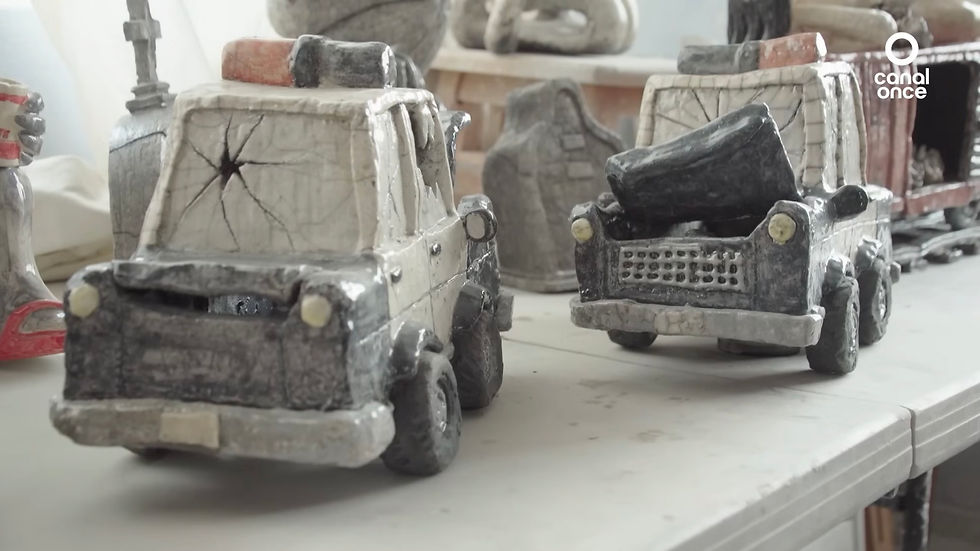
As artists ideologically and symbolically committed to smashing the system,
it is ironic that Eles Crew are now predominantly working in ceramics; however, not to fear, their method is both an act of revolution and anarchy. Like the laws that are rigorously implemented and upheld by the secular and theocratic elite, Eles Crew deploys the precision and preciousness of ceramics in order to smash them up and demonstrate how fragile all constructs are when you have the persistence and patience to eradicate the symbols of oppression at the same time as resisting the system itself.
“We deal a lot with the fragility of ceramics,” Larpo continues. “It’s a very orthodox material. You have to follow exact steps to arrive at the perfect formula in terms of clay, glazes and construction. We’ve been very anarchistic in this respect.”
After following the steps to create within an art tradition that is legitimized by the canon, Eles Crew smash it and then put it back together again, the cracks and imperfections as a reclamation of the canon on their terms. Like Ajusco Bronx, the art of Eles Crew always starts on the street; the neighbourhood is an inspiration representing a culture of site-specificity. “You feel the essence of where you’re from, and it inspires you.” And even when exhibiting in art shows all of the artworks are anonymous; the art and anarchy of Elis Crew is a literal part of the community sapped of any semblance of an individual.

With the diversity of culture contained in the 12 episodes of Cronicas de Barrio Season One
spanning more content like Volkswagen Beetle taxis with their ability to climb the steep hills on the edges of the city because of their front engines and front wheel drive, to a senior citizen marathon runner dressed in a tapestry of teddy bears as he motivates young people to exercise, Aguirre and his crew are committed to showing us the traditions — and innovations — that are thriving in the marginalized communities thus far beyond the reaches of gentrification. As pescadero (fish monger) José Alfredo Castañeda points out, “markets are the refuges for traditions” and, indeed, this sentiment can be extended to the barrios themselves, alive, beating and open for celebration on the periphery of Mexico City. “Everyone wants to be heard,” Aguirre explains. “Everyone wants to tell their story and it's very heartwarming. When we finish, everyone thanks us. And some have said: "Thanks for looking at us” — and, in so doing, thanks for defending the diversity and resilience that is the corazón of Mexico City.

Postscript:
During our interview, I asked Iván Aguirre: Why this show now? Since the liberation of the Mexican people in 2018 from over a century of exploitation and oppression by the neo-liberal governments of PRI and PAN by the revolutionary socialist Morena government, is there any connection between highlighting communities that have been either ignored or misrepresented as dangerous and, because of this misrepresentation, communities that are integral parts of the diversity of culture that have been marginalized for decades? He responded how:
“For us to look at the barrios is to look at everyone to dignify our lives. Our country. Morena came from the barrios, the communal pride and committees, a renegade form of governing and social organization in the face of external exploitation. In many ways, what Morena stands for originated in the barrios. Social organization comes from the barrios. The origins have trickled up. All of the people in power now came from the barrios. I am seeing it firsthand; I have learned from the people not because they are politically minded. Three generations ago, young people organized for basic survival. For schools and water. It’s a revolution of survival that has trickled up.”
Just like the people who settled on the pedregal took their housing into their own hands in the late 1940s in order to survive, Mexico City’s barrios’ grass-roots impetus for survival has reached the realm of government. The telling of the stories of the barrios’ diversity of culture at the heart of Mexico City is finally receiving its due. In community, the people always know not only who they are, but also what they need. And now they are not only being asked, they are telling us.

Cronicas de Barrio won best documentary at the Pantalla de Cristal awards, the most prestigious TV award in Mexico.
The Executive Producer is Daniela Paasch.
You can access all of the episodes of Season One of Cronicas de Barrio here.
*
About the Artist:
IVÁN AGUIRRE (Chihuahua, Mexico. 1981)
With studies in cinematography in Mexico’s prestigious CUEC at the National University, and of English Literature in UNAM’s Faculty of Letters and Philosophy, Iván Aguirre has built a career in the areas of screenwriting, direction, production and post-production in several series of Mexican Cultural Television, working in channels 11 and 22, the two most prominent public service broadcast channels of the country, among others.
As screenwriter he was part of the award-winning show Bizbirije, the fiction series “Futboleros” (Soccer lovers), and the comedic magazine “El show de los Once” (Once’s Show), internationally awarded TV programs for children, aiming for education, inclusion and entertainment.
During the pandemic he coordinated a team of more than 60 academics and screenwriters for the multi-format series “Aprende en casa” (Learn at home), the National Ministry of Education’s effort creating a teaching strategy in multi-format TV content aimed at high school students all over Mexico.
As a director, editor and screenwriter in the documentary film realm, he has created series focusing on social and scientific issues like “Islas de México” (Islands of Mexico), about the biodiversity of Mexico’s seas and islands, "Ecos Indígenas: la voz de la diversidad" (Indigenous Echos: the voice of diversity) about radio stations in 12 different indigenous languages, "La Ruta de la Ciencia" (The Road to Science), dealing with science museums around Mexico, "Pinta tu barrio" (Painting the Hood) a series about street artists in challenging urban settings, and “Aprender en comunidad” (Learning in Community) a show about teachers working in the most remote and poor communities of the country.
To this day, he teaches Film Aesthetics and Film Narrative at the Mantik School of Cinematography in the Churubusco Film Studios, south of Mexico City.
Ecos Indígenas promo: https://www.youtube.com/watch?v=yADCcDg0Wqs (Chihuahua, Mexico. 1981)
Islas de México promo: https://www.youtube.com/watch?v=4NqnRyBDjuM
*
About the Writer:
KAREN MOE is an author, art critic, visual and performance artist, and feminist activist. Her art criticism has been published internationally in magazines, anthologies and artist catalogues in English and Spanish and she has exhibited and performed across Canada, the US and Mexico and has spoken on sexual violence internationally. She is the author of Victim: A Feminist Manifesto from a Fierce Survivor . Her next book is a collaboration with Pacheedaht Elder Bill Jones entitled, Listening Once Again to Our Great Mother: The Fairy Creek Blockades and the Life Story of Pacheedaht Elder Bill Jones will be released on September 1st, 2026 with Dundurn Press. Books are now available for pre-order at your favourite bookstore. Karen lives in Mexico City and in Lantzville BC, Canada.
IG: @karenmoeart


Comments