

An Unflinching Love Affair with All that is Being Lost: Kyle Scheurmann’s We Could Have Been a Mountain.

Updated: Apr 25
By Karen Moe

The paintings of Kyle Scheurmann’s latest collection,
We Could Have Been a Mountain, could have been just beautiful. They could have been landscape paintings celebrating the spirit of the Canadian wilderness in the tradition of the Group of Seven or the West Coast glory a-swirl in the old-growth epics of Emily Carr. We Could Have Been a Mountain could have been aesthetic articulations of a love affair with the land, alive with the natural environment that is distinctly Canadian. And they are. However, unlike Emily Carr and the Group of Seven, these paintings are of a far different time. This is a love affair conflated with a broken heart, painted articulations of what could have been before greed has almost finished its job. Scheurmann paints ecological trauma; however, even as the natural world is obliterated around us, his love and connection to the land is what animates these exquisite reportages of the stories told by the scourge of capital—and the beauty and resistance that persists.
As an activist, journalist, conservationist and artist who has been a forest defender in
old-growth forest logging blockades like the Fairy Creek Blockades in 2020-2021, and now, with this new work, investigated sites of the endemic forest fires that have accelerated in his home province of BC and across Canada, Scheurmann’s artwork is passion and subjectivity built upon the bedrock of the painstakingly objective. He analyzes and monitors clearcuts, forest fire burns and the threatened patches of what still stands with the precision of a scientist, photographing, recording GPS coordinates and taking physical samples to his studio as a biologist takes specimens back to their lab. The artist’s site-specific sketches are as subjective samplings and, perhaps most importantly, Scheurmann immerses himself physically and emotively into his subject matter and, as witness and as living creature, the artist becomes a part of his analysis and art.

“My hands and feet became sticky and ashened,”
he reports after investigating the site of a recent forest fire, “as I felt the caramelized sap of freshly burnt branches crumble against my skin.” Along with an endless cycle of intensified love and renewed heartbreak, the artist embodies his earth-muse as his subjectivity becomes a specimen of emotion that he accesses as he paints. Materiality from the sites of the devastation does not only manifest itself on the artist’s skin and within his psyche, however, it literally becomes a part of the artwork. “Slash Pile,” located from the site of what was Sassin Forest on southwest Vancouver Island, contains ashes from the fires that raged and bones of the animals that weren’t able to flee; there is reclaimed iron oxide and oil as evidence of those responsible. And, in almost all of the paintings, there is sand, earth fire-leeched of the nutrients that once supported millions of living creatures. Like a kid in a chemistry class, the artist whips his paint into merenguey peaks and adds his ground up ingredients that he then layers upon heavy linen with the finest possible brushes. Even the dents in the canvas become a part of conversation as these stories are painstakingly inscribed to materialize a pulse of love and outrage. Mimetic to the land that he strives to save through art, these paintings are bodies telling stories of what is living, dying, and struggling to be reborn.
Scheurmann’s stories originate in his emotional response to place and what metaphorical waterfall he will almost jump from (perhaps the thought does cross his mind as land defenders most often lose to industry and complicit governments) or from the top of which slash pile he will holler. Sassin Camp is the site of the painting “Slash Pile,” an old growth forest that the artist lived and communed with and, after the loss, he returns to visit every year.

“I went and visited it when it was just a big rotting hole in the ground
and then this summer 2025 it was on fire,” he reports before taking that anger into his studio to create a burning epic of rage where ravens, stellar jays and hawks are a-flight on fire, deer hurl themselves from the epicenter inflamed, the RCMP stand surveilling us as we surveil them, a tell-tale hand of authority palm forward denying witness, as chainsaws and oilcans are littered in harmony at their feet.
In “The End,” framed by evergreens adorned by flames and beneath a star-gemmed sky, we behold a waterfall that the artist came upon in Chilcotin territory in northern BC during his research on forest fires in the summer of 2025.

“We found this incredible waterfall that kind of drained into nowhere,”
Scheuermann explains. “The waterfall is near the site of what is known as the Plateau Fire, the biggest forest fire in Canadian history where several fires converged.” In lived experience, the torrent of water lands in what has become nowhere; in the painting, a young man is poised to jump, his despondency having reached the limit where all he can do is end his life and merge with the land he lives to save. “Fall Together” shows us all doing just that—on the surface against our will—as we are hurled over the edge by the cumulative force of lack of action and apathy in our innocent canoes that had skimmed lakes and ridden rivers in what was once only wonder. And then the painting which perhaps doesn’t need a name: a human is searching, the beam of her flashlight a beacon, having decided to cross the bridge of re-connection as two ravens swoop down from the forest and into the light of her search to greet her.

The detail that energizes Scheuermann’s art
is particularly vital in the painting, “We Could Have Been a Mountain.” Where all of the other paintings in this series originate in one particular location, the title piece is a collage of place. Centered in Wells, BC, the painting is an amalgam of locations Scheuermann collected along the way. With a flurry of an unrestrained science experiment, the artist constructs what could be seen as an aggregate of empiricism, and then cuts a cross-section within which everyone and everything is present. We can feel the blast of the forest fire as lightening feeds its spread; fire bombers are as barely discernible insects inanely circling, industry trucks are just plain leaving, and, in the centerpiece of the painting, human salvation still stands—for this painted instance, anyway. On a tiny island there is a lone wooden house wreathed by flowers. People are paddling frantically towards it in their delusion of human safety in the middle of an apocalypse. Through the cross-section, underneath the house, dead salmon lie side-by-side along with doppelganger chainsaws; however, in a gesture of ambivalence, salmon leap up the waterfall as representations of escape—or possibility?

“Forest fires are natural,” some people dismiss the ecological disaster.
“The forest will always regenerate itself.” And yes, that is true; to a certain degree, the earth will heal even though old growth forests will take millennia and, with the acceleration of climate change, who knows if that is even a possibility in a non-cognitive span of time. And, yes, forest fires do exist in the wild, driven by lightening to clear undergrowth and allow for new growth. However, this is certainly not to an extent such as the summer of 2023 when 15 million hectares of forest in Canada burned. Scheuermann, though, as an artist committed to showing us everything doesn’t exclude such samplings of the forest regenerating itself. The majority of the paintings contain fireweed, a pretty purple wildflower that is prevalent in clearcuts and burned-over land. The artist dries the flowers and either crushes and mixes them with sand and bone into the body of the paint or they are part of a mixture of site-specific materials that he sprinkles on top of the layers of wet paint as one sieves icing sugar onto a cake. In some paintings, the delicate petals of the flowers that cover burned-over lands are carefully placed in the wet oil paint, so they poke through or are still visible beneath the painted surface—their pink innocence a scab and a re-birth.
In the painting “Morels,” with the tell-tale forest fire of this series still raging in the background, humans, deer and rabbits feast on a patch of morel mushrooms that have sprung up in a glade of scorched trees and stumps. Scheuermann tells the story of his last day researching the forest fire in Wells BC when he and his friends came upon a patch of morels, the prized mushroom jam-packed with nutrition that thrive on land that has experienced recent disturbance, in particular post-forest fire.

“Morels were literally growing from the ashes of wildfire.
As our last act in Wells, we sat quietly together and tasted the fire.” The artist and his friends are, perhaps paradoxically, nourished by life that thrives on destruction.
The fireweed and the morels grow out of ecological devastation, and the patches of prized mushrooms and scorched fields of fireweed would have happened anyway, but certainly not to the extent wreaked by the human-caused trajectory of clear-cutting, global warming, pine beetle and endemic forest fires. Yet, in the midst of what is nothing short of an ecological massacre, the paintings tell stories of beatific instances of the earth healing itself and resisting as best it can. The earth still gives back even when we have scraped it bereft.
Like the land resisting, so too are the hands of a forest defender in the painting “Tripod.” Perched on top of a towering tripod that is guarding a forest encroached upon by a clearcut and the forest fire guaranteed, a forest defender defiantly rejects the Injunction order being handed to her by the RCMP. He is backgrounded by the flaming mountainside, reaching from the bucket of an industry excavator; she is allied with an eagle and her tripod is encircled by flowers. As a police officer and a witness wonder at her ferocity from below, a logger stands despondent with his chainsaw hanging impotently from his hand and about to fall to join the others lying defeated at his feet.
As the last of the ancients in BC are being cut and all are threatened,
the artist, like all environmentalists, is desperate. The majority of Canadians do not want the old-growth forest cut, and even those who deny the connection of clear-cutting with the acceleration of forest fires certainly don’t like it when they are evacuated and maybe lose their homes, not to mention having their summer ruined as they cough on hazardous fumes. With art as his primary activism, Scheuermann’s paintings are a compassionate ploy to rouse us into acting on what we believe in. With gooey, almost yummy, irresistible beauty, he seduces us to come closer and look deeper to read the lovingly inscribed stories of what is going unnoticed. As we lean in and look deeper into the layers of what he calls “slow painted journalism,” we see what’s happening to the forests and the natural world that we are all a part of, as told to us by the artist’s unrelenting love affair.
“Come, look, search, feel, know,” the paintings call to us. “Only then will there be real hope.” Only then can we come together as a mountain.

We Could Have Been a Mountain is showing at Baux-Xi Vancouver
from April 11th to 28th, 2026.
About the Artist:
Kyle doesn't have an artist statement. His work speaks for itself. However, here is some important information that we're sure Kyle would like us to share that we found on the Baux-Xi website:
"Scheurmann has been working towards systemic and legislative approaches for permanent environmental protection, including aligning himself with the conservationist group, the Nature-Based Solutions Foundation (NBSF), as the founder and chief organizer of the Art Auction for Old-Growth. He was also involved with the foundation of a new environmentally focused residency at the Harvest Moon Learning Centre in Clearwater MB, collaborating with experimental regenerative farmers in order to share holistic approaches to land stewardship as a means for new art."
You can always keep up with Kyle through his Instagram: https://www.instagram.com/kylescheurmann/
*
About the Writer:
Karen Moe is an author, art critic, visual and performance artist, and feminist activist. Her art criticism has been published internationally in magazines, anthologies and artist catalogues in English and Spanish and she has exhibited and performed across Canada, the US and Mexico and has spoken on sexual violence internationally.
She is the author of Victim: A Feminist Manifesto from a Fierce Survivor Vigilance Press (2022). During her North American Tour, she was presented with the “Ellie Liston Hero of the Year Award” by the DA of Ventura County for being instrumental in the life sentence given to a serial rapist. Victim has recently been translated into Spanish and is being adapted for film.
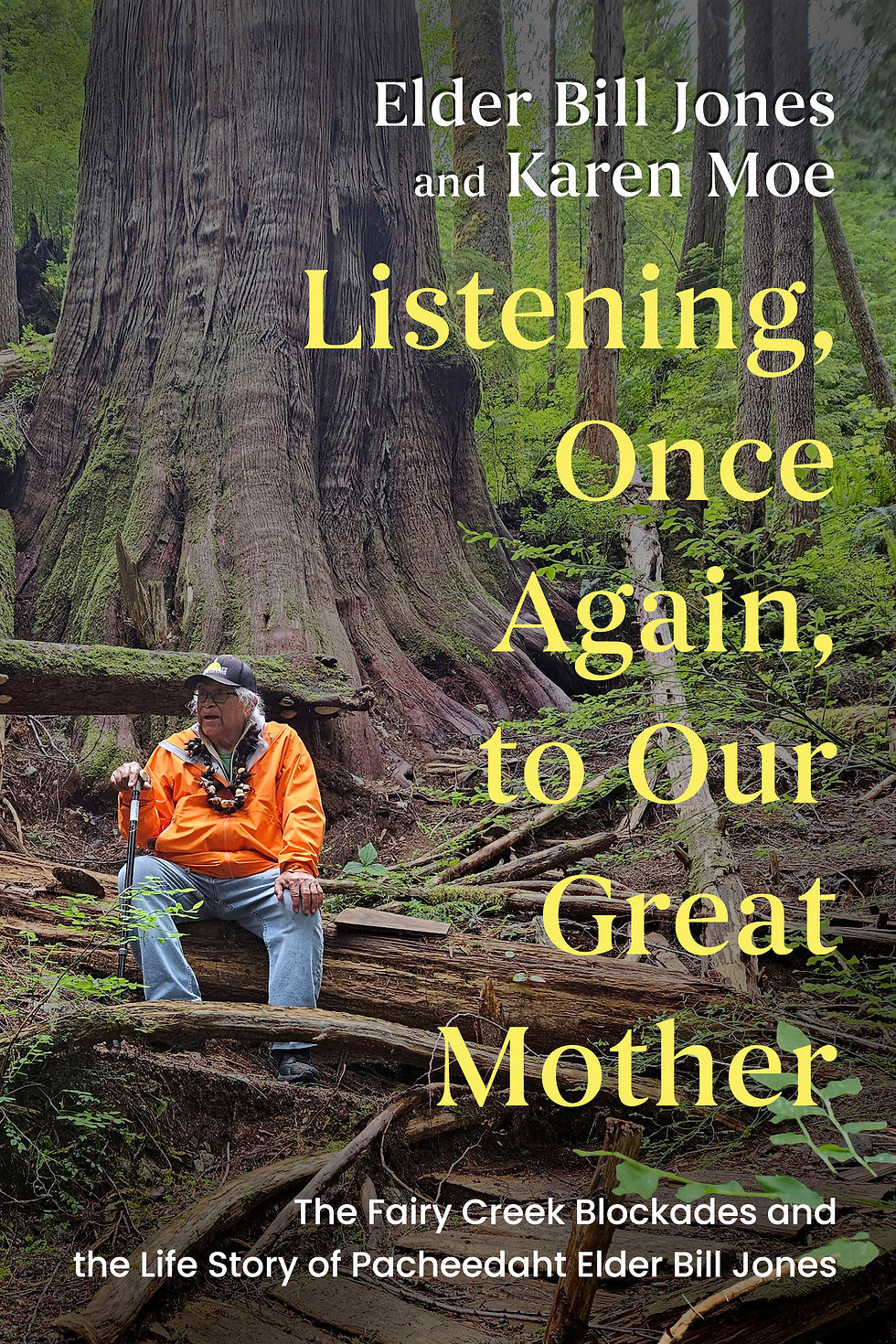
Her next book is a collaboration with Pacheedaht Elder Bill Jones entitled, Listening Once Again to Our Great Mother: The Fairy Creek Blockades and the Life Story of Pacheedaht Elder Bill Jones that will be released on September 1st, 2026 with Dundurn Press. Books are now available for pre-order at your favourite bookstore.
Karen lives in Mexico City and in Lantzville BC, Canada.
IG: @karenmoeart
*


Comments