

Always to be continued ... The Enforcement at Eden

Updated: Jan 26
Introduction by Karen Moe

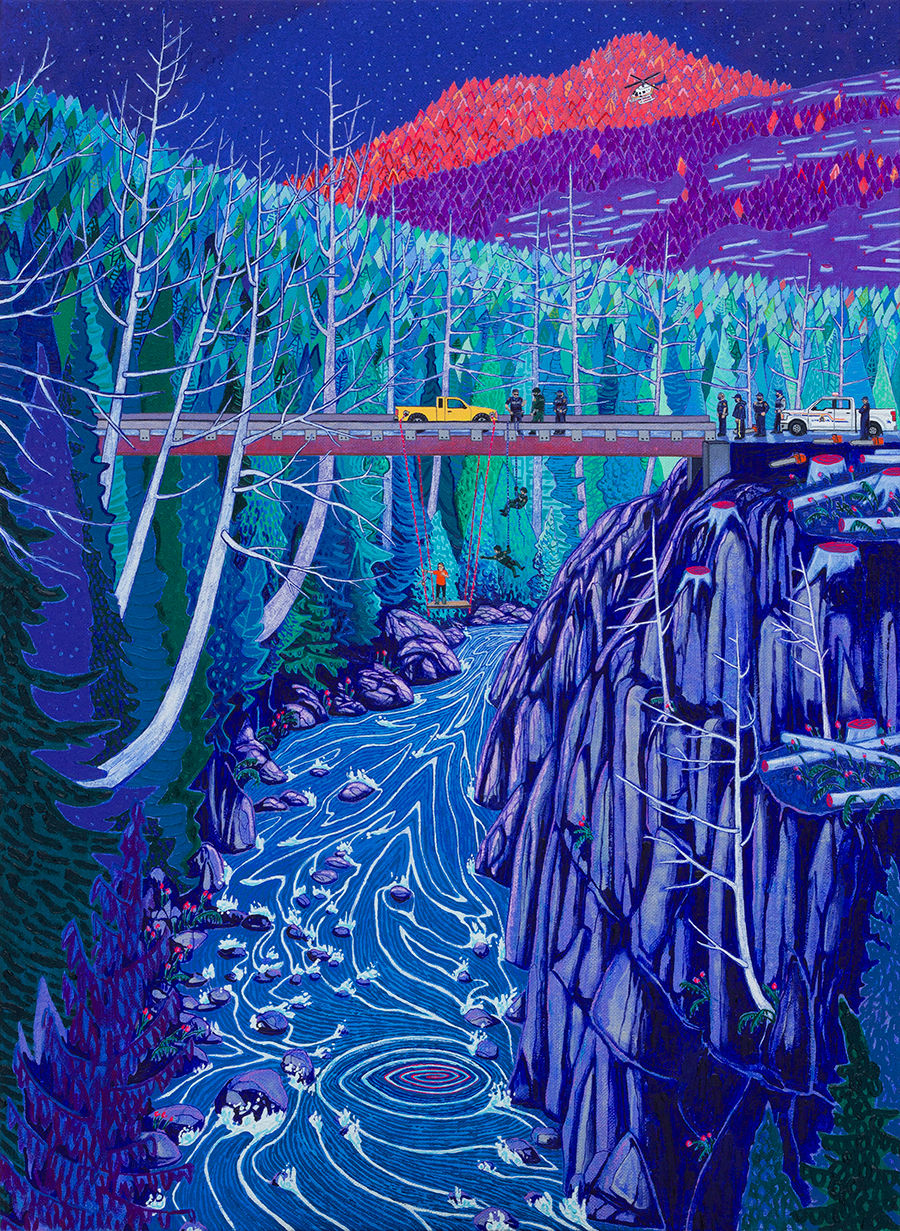
Kyle Scheurmann "Hold On Mahki (Sleeping Dragon)" 2021 48" x 60" oil on linen. Image courtesy of the artist.
He doesn’t miss a beat.
His paintings of Eden Grove of the Fairy Creek Blockades in 2021 are obviously by an artist who lived it—both the beauty and the horror. The still standing forest, the strewn fallen trees, the forest defenders locked determined in their hard blocks, the excavators perched ready to gouge, the RCMP with their oblivious arrogance as servants of the crown and industry wreathed by chainsaws and police tape, and, as in the painting “Hold On Mahki (Sleeping Dragon),” the artist has even included the hand of a law enforcement officer, palm raised in the direction of the artist, in a gesture of keep out, keep away, you are forbidden access to the truth. However, undermining this gesture of censor that was prolific during the Fairy Creek Blockades, there is the detail that defies all censorship: the hand of the Forest Defender lying prone in a sleeping dragon is reaching beneath the surface of the exploitation roaming above, locked onto and holding a root.
What became the series Hold On that was exhibited at Bau-Xi Gallery Toronto in 2022, Kyle Scheurmann’s paintings of Eden Grove are alive with every detail because the painter and forest defender was there the day Eden Camp fell. And he had been there long before that too, from the beginning of the camp as it grew into a blockade in March as a defender and as an artist as witness to what, in his words, is happening when no one is watching. These paintings are hyper-real, an aesthetic that can make reality so acute it guarantees emotion in order to make the viewer feel the truth. Still standing forests are as stained-glass beautifying mountainsides, while others are scabbed by clearcuts, and the fallen trees are still bleeding onto their now barren land. Originating from an artist/activist who feels the beauty and the travesty of the loss of another one of the last remaining groves of old growth forest as one who communed with the trees and all the life that lived there, the paintings of Hold On compose a cross section of what really happened, replete with the cores of the cut trees as meat exposing slaughter.
Also a writer, on Wednesday June 9th, 2021, Kyle returned to Eden Camp as media. What follows is the article which was included in his 2022 exhibition but was previously unpublished. We are honoured to publish it now, in January 2026, as the fight to save some of the last remaining patches of ancient forest on Southern Vancouver Island continues in the Upper Walbran, Edinburgh Mountain and now, as we write in mid-January 2026, near the Gordon River.
In the Upper Walbran, Western Forest Products is responsible for this latest push to take everything until it’s gone. Flexing their despicability, the colonial corporation has allied itself with the Huu-ay-aht First Nations—one of the many First Nations who continue to be coerced through poverty and corrupt Indian Band Councils to consent to the destruction of their ancestral territory—with the formation of the Tsawak-quin Forestry Limited Partnership. As Pacheedaht Elder Bill Jones says: “Government and industry are using a new tactic … Their tactic is not to log it themselves. That'll be white guys against Indians. They're saying, ‘Hey, let's get the Indians up there.’ And then the colonial corporations and government, still receiving most of the spoils, can hide behind a politically correct Indigenous names.[1]
To make matters even more despicable, Tsawak-quin Forestry Limited Partnership (Western Forest Products), is currently petitioning the Crown for a criminal case against Pacheedaht Elder Bill Jones and the Forest Defenders of the Upper Walbran. This is along with the criminal case granted to the logging corporation Teal Jones by the Crown against Elder Bill and 14 other defenders deemed central to the Fairy Creek Blockades from 2020-2021. Both corporations are suing Elder Bill and the Forest Defenders for millions of dollars. Kyle’s article, “Enforcement at Eden” and the series “Hold On” that followed, are a celebration of spirit and an act of mourning for what is still being lost in a fight that, as long as we are governed by greed and despicability, will always to be continued …
*
See Instagram @fairycreekblockade and Facebook Ada’itsx/Fairy Creek Blockade for daily updates and ways to support the defense of some of the last of the ancient trees and pristine eco-systems on earth that not only support millions of non-human creatures—many threatened by extinction—also store 1,300 megagrams per hectare (with one megagram being 1000 kilograms)[2] making old growth forests invaluable in the fight against global warming and maintaining a livable planet for you, your children and future generations.
Karen Moe.
*

Enforcement at Eden by Kyle Scheurmann
Wednesday June 9th, 2021
The media invite for the day arrived about an hour and a half earlier than usual. Something must be different about today. While fueling up at a Lake Cowichan gas station, a text from the Eden Camp satellite phone confirmed it: “Enforcement on at Eden 6am. As of 7:45 Hygelli arrested and released without charge. Mahki the only one who was able to lock down in a dragon at the gate.”
Today my plan was to be part of the media team escorted by RCMP. This meant losing out on a chance to document the early moments of the day when RCMP first arrived at camp, but it also meant far greater access to police activity once I did arrive. It also kept me safe from arrest. I was the only member of the press to join the media convoy headed to Eden, others had staked out spots at different camps on their own.
Driving up Gordon Main Rd., I kept thinking about the irony of what I was about to witness. At that very moment, John Horgan was preparing to make an announcement about old-growth logging deferrals in the Fairy Creek watershed. After a week that included announcements by Pacheedaht, Ditidaht and Huu-ay-aht Nations as well as Forest Minister Katrine Conroy about selective deferrals in the area, it was assumed that Horgan would be reiterating these statements while acting as though it was a big deal. (This ended up being exactly what he did - he called it ‘monumental’) However, also in that moment, RCMP were preparing a heavy-handed enforcement against an indigenous Forest Protector who was willing to give up some of their liberties in effort to save a piece of forest growing just outside of the deferral area. The government was acknowledging - and even celebrating - the need for deferrals while simultaneously, their primary law enforcement unit was preparing a strong gesture of force in the complete opposite direction. The urgency of the moment on the ground at Eden pushed the politics of the story out of my mind as soon as I arrived on site.
Pulling up to the gate at Eden on unceded Pacheedaht territory, one of several camps making up the Fairy Creek Blockades, was something I’ve now done countless times in the last 3 months, it’s become a home-away-from-home. When I first started my time there as an Artist in Residence, there wasn’t even a gate - just some pylons across the road in front of a bus backed up against the Edinburgh Main Bridge; the bridge that gives access to Eden Grove, Big Lonely Doug and the site of approved road building through old-growth for Teal Jones to continue their ‘harvesting’ of the land. With the pressure of the injunction and increased visits from the RCMP Division Liaison Team (DLT), the gate was moved up the hill by about 300 metres to the intersection with Gordon Main Rd. where it would be easier to manage the flow of both tourists and police.

A large communal tent was set up with a fire pit outside. The frame of a tripod (the name for the structures Forest Protects have been climbing on top of while blocking roads) stood in the triangular centre of the intersection. An old bike lock, some rebar and two barrels of cement formed the gate that could swing open to let cars pass. This was the site of nightly ‘Circle’ meetings, it was the info centre, morning coffee hangout spot and late night place to share stories.
On the morning of June 9th, it was an RCMP exclusion zone.
I took my first photo just past 9am when the media convoy finally arrived. Mahki, from Michif Nation, was locked shoulder-deep into the earth, laying directly underneath the gate. Yellow police tape was wrapped around the posts of the Tripod and the tent, delineating the space where a handful of other Forest Protectors could sit and watch. Daystar was serving as the legal observer, wearing an orange vest while sitting inside the police line about 10 feet from Mahki. Daystar burned medicine harvested from their territory - treaty 6, Amiskwaciwâskahikan. Roughly 10 police vehicles and about 20 RCMP officers littered the road all around us. The Forest Protectors were outnumbered 3-1.

Just a few days ago, Mahki told me while sitting near the gate, “As an indigenous person, I understand how connected we are to our territories. Even though I’m a guest here, on Pacheedaht territory, I still understand that the people and the lands are connected. It feels amazing to come here in support, I’m doing everything I can.” Now, in the face of RCMP force while locked under the gate, Mahki looked calm and confident in their commitment.
I learned that enforcement had shown up around 6am. The injunction was not read at the time. Forest Protectors were corralled on the road outside the gate as RCMP immediately began to dismantle the installed tactics and infrastructure. I do not know what the Forest Protector’s planned roles for the day were, as made at Circle the night before, but somehow, Mahki found their way into a sleeping dragon - the only person to utilize any of the intricate tactics developed over the last several months. Hygelli had been arrested then immediately released and now sat with the group in solidarity with Mahki.
Although I’d been preparing for this moment for weeks now, I didn’t expect to feel so conflicted. On the one hand, I was there to work. I’d received access to the media convoy on behalf of Focus Magazine and XRTV to document the activity on the ground. This was something Forest Protectors at Eden had agreed was a valuable role to fill as it would give me safe access to all parts of enforcement when it finally did arrive - someone needed to be behind the line taking photos. But on the other hand, I could not be there to participate. I had to stay neutral. I couldn’t call out encouragement to Mahki while RCMP chiselled away at their arm in the ground. I couldn’t console my emotional friends coming to terms with the narrative of the day. I couldn’t even share a camera battery with a friend trying to get whatever photos they could from the limited viewpoints available.

During the extraction,
Two Forest Protectors were escorted to collect their personal belongs on the other side of the gate. Rufus and Hyggeli consoled each other behind the ‘Welcome’ sign constructed to orient tourists. RCMP cut through the bike lock holding the gate together and removed it from overtop of Mahki.
Edinburgh Mountain stood in the background, framing the scene - the piece of Pacheedaht territory that Eden Camp was specifically there to protect.
Since the recent discovery of 215 murdered indigenous children at the site of a Kamloops residential school, orange shirts, pins and hats had been something several Forest Protectors wore in memoriam. Some camps held daily 2-minute silences at 2:15 since the day the news broke. Today at Eden, several RCMP were wearing orange ribbons pinned to their uniforms.
Daystar pointed at one officer’s ribbon with an eagle feather, “I see you’re wearing an orange ribbon.” The officer responded, “It’s to honour the 215 children.”
“Isn’t that a contradiction, since you’re arresting an indigenous person?” Daystar was ignored.
At 9:45 am, a backhoe moved in to break up the ground around the sleeping dragon that Mahki was locked in. How much money is this all costing? Heavy machinery, an assortment of power tools and countless labour-hours split across several different types of specialized police.
Just last week, I watched Chickweed dig the hole and install the sleeping dragon mostly by herself using only her hands and a shovel. She dug a hole almost as deep as she is tall. Since the injunction was passed, Eden had been subject to several low flying RCMP helicopter flyovers as well as RCMP road blocks at both points of access to camp and visits from the DLT. Enforcement was happening at several camps all around Eden. “The longer they leave us, the stronger we’ll be,” Chickweed told me on a break from digging.
She’d recently gone to another camp to serve as a legal observer and saw how RCMP are enforcing the injunction first hand. “Witnessing all of that really strengthened my resolve to support people who are willing to put their bodies on the line. If I was hesitant before, now I’m all in. I’m here to stand up for the land which has been continuously occupied and exploited and destroyed by colonial capitalist powers. The destruction of land goes hand-in-hand with the destruction of indigenous communities and violence towards indigenous people.”

The backhoe scraped away at the earth
until there was once again a person-sized hole in the road. Except this time, it wasn’t Chickweed in the hole, cementing a tire full of rebar deep into the soil. It was an RCMP officer in a jumpsuit and gas mask throwing a pickaxe in the direction of Mahki’s hand.
At 10:10am, the RCMP media escort walked over to me and offered to take me past the gate to see what was happening on the bridge. I didn’t want to miss anything happening with Mahki but couldn’t pass on the chance to see the rest of the camp which was now completely isolated behind the exclusion line. I slipped through a crack in the cedar planks that once were the edge of the gate. Only a few feet from the extraction, I clicked the shutter on my camera as many times as I could in the direction of Mahki.
I’d walked up and down this hill so many times from the gate to the kitchen at the foot of the bridge. Most often with other Forest Protectors on the way to Circle or walking back down to make some food. But I’d certainly never walked it with a police officer before. I tried to keep track of the hidden tactics we passed, now sitting un-utilized with their prospective occupants huddled together under close RCMP supervision. I didn’t say anything to the officer, but he had a lot to tell me.
“The protestors had this platform under the bridge with a wire going around the bridge, and it’s connected through the middle of a truck, and there’s a sleeping dragon in the middle of the truck, plus there’s a bus or something tipped on its side at the end of the bridge with something painted on the roof. ‘Save Something,’ or something rather, I think it says.”
He was wrong. The roof of the bus said “LAST STAND”. I knew because I painted it.
We walked past the kitchen and the wall tent, past the 3 large logs anchored into the ground that were kept as a shrine - now strung with police tape. RCMP let me walk right up to the edge of the bridge.
This bridge crosses the Gordon River in a particularly choppy section. Fast rapids loudly rush 200 feet below while candelabra stick out from the edges of the steep canyon on either side. It’s a place to reflect. Most days I camped at Eden, I slept on the far side of the bridge, meaning I had to walk across it more regularly than others. Often on these crossings, I’d find a Forest Protector sitting quietly on the rail, looking down into the water. I learned to not interrupt people in these moments.
Today, I found an entire tactical team of RCMP officers clad in military-green uniforms. There were several of them, spread out on top of the bridge and even below it, dangling from the sides like parasites. They scurried to make quick work of the empty hard-blockade tactics set up on the bridge, or, “cleaning up the mess,” as one officer put it. The backdrop for their work was the red glowing letters of LAST STAND on the roof of the flipped bus, spanning the width of the road at the end of the bridge.
Their first goal was to retrieve the platform set up as a nest under the bridge where, in an ideal enforcement scenario, Lou was to wait out the police. A wooden plank from the edge of the platform snapped off as RCMP attempted to hoist it over the edge. It twisted in the wind as it hurled towards the river. “You don’t see things like that every day,” one officer said to me.

However, if you’ve been around Eden Camp lately,
the platform under the bridge was no surprise. Lou had been working on it for weeks. The plan was for him to attach himself to a climbing harness, then walk along the beams under the bridge before finally belaying himself down to the platform. There he’d left a bucket of food, some things to keep him dry and a sleeping dragon cemented inside of an oil can fastened to the platform. He’d even taped some Cliff bars to the bottom of the nest in case RCMP found a way to steal his
stash. The platform was in part supported by a long cable that looped right through the middle of a pickup truck on top of the bridge. The tactic worked so that if the truck was moved or the cable compromised, the platform would fall. A large sign reading ‘On The Line for Ancient Forests’ swung below the platform. Hyggeli was also trained on how to access the platform in case Lou wasn’t around on the day of enforcement. None of that mattered anymore.
During my time camping at Eden, I climbed under the bridge a couple of times with Lou to check out his work. So much effort and thought went into setting up this platform. So much personal risk as well. I’d seen other tactics at other Fairy Creek blockade camps and immediately thought there was no way I would be brave enough to perform it - as recently highlighted by a person falling and being injured from the top of a Tripod when RCMP failed to properly execute an extraction. Lou was risking his life just in the act of installing this tactic, never mind in trusting the RCMP to extract him safely.

One afternoon, Lou and I stood under the bridge
taking shelter from the rain while looking out at the waiting platform. “It’s been a wakeup call for me to see first hand how poorly we’ve treated the people here and the land we are on. We as settlers have just came in here to take. It’s been hundreds of years of taking and taking and there are wounds that now need to be mended.”
That moment under the bridge now felt like a different universe. Today on the bridge, around 10:20 am, the tactical officers didn’t seem very happy that I had been escorted to watch their work. One of them came up to me and said, “do you think you have all the shots you need here?” He stood right in front of my camera lens. It looked like it would still be a while before they completed their work and I didn’t want to miss anything with Mahki at the gate anyways, so I walked back up the hill with the escort. This time, I noticed some of the other sleeping dragon holes along the road had been filled with expanding foam cement. All of the preparation seemed to have been compromised.
Passing the gate again, I snapped as many quick photos as I could of Mahki up close before returning to the far side of the police line to watch the rest of the extraction. The extra steps Chickweed had taken to install this dragon worked well. Some cement had gone up inside of the metal tube Mahki’s arm was in, making it difficult for the officer standing in the hole to unhook the chain on Mahki’s wrist. But it didn’t last long. At 10:40 am, Mahki was out.
In other extractions I’ve witnessed, Forest Protectors have stayed motionless once unhooked from the dragon, forcing RCMP to waste even more time by picking up their limp bodies, loading them onto carts and wheeling them away. But Mahki didn’t do that. Mahki stood up proudly, put both arms out to the side and walked to the police car with confidence. As they passed the Forest Protectors, separated by yellow police tape, Mahki put a fist up in the air. There was more to be gained in that moment of connection and community than there was in a few more minutes of RCMP inconvenience. It’s what I remember most from the day.
Within seconds of Mahki being unearthed and walking from the site, the backhoe began to push dirt back into the hole. Daystar yelled at the RCMP, “You all remove those pins! You are not allowed to wear them! Blood on all your hands! Blood on all your hands!” RCMP ignored the call. Carcass read aloud a poem called ‘Colonialism: A Love Story’ by Billy-Ray Belcourt, shouting to be heard over the machinery and punctuated with the line, “COLONIALISM. Definition: turning bodies into cages that no one has the keys for.” RCMP ignored the call.
Later on, Daystar would tell me, “It was a horrific reminder of my own family members that are survivors of residential schools and day schools. A reminder of those poor babies. Many more children’s graves are to be unearthed.”

The enforcement plan quickly shifted to clearing the area of people.
I did not want to be lumped together with the rest of the cars, so as RCMP began to corral Forest Protectors, I asked the press escort to take me back to the bridge to finish watching the clearing of the camp. To my surprise, at 11:00 am, he agreed. So we walked back down the hill once more.
This time, I was alone with RCMP, some heavy machinery operators and industry. It turned out that the tactical team was unable to get the platform back onto the bridge using only their bodily strength. The weight of the cemented dragon was too heavy so they needed to wait for the backhoe to drive down the hill and help now that Mahki’s extraction was finished.
One officer told me to come check out the kitchen. “Look how many things they have in here, they sure were creative about building up their stuff.” Some loggers pretended they were tour guides, reading off the signs posted on the back of the kitchen about the endangered Goshawk Forest Protectors were trying to find in the area. Another stole a hand painted sign from up in a tree.

“All property is to be handed over to industry,”
an officer reminded everyone standing around waiting. Immediately, a few people went over to check out the solar panel that had been set up by the kitchen. It had been smashed. They walked away disappointed.
On the bridge, I watched as RCMP posed for photos on their phones. In one, an officer held up a large wooden cutout of a Sasquatch. It had been around camp since even before I first visited. Another officer put on the frog mask which had been a part of the artist residency. He crouched for a photo as though he was about to hop right off the bridge. An officer excitedly told me they were about to launch a drone and showed me where to stand to get the best photo of takeoff. I obliged, hoping the drone would crash right into a tree.
I walked over to the 3 shrine logs sticking out of the ground and a logger followed me. Next to a candle and some stones at the base of the central log, there was a massive cedar burl that Chickween and The Woodsman had found while out on the Bugaboo one day. The logger picked it up and proclaimed “I’m going to make a bowl out of this one, I do lathe work, you know.” This same logger would later question me about who I was working for and insisted that I didn’t use his photograph in any publication. Maybe my unwillingness to joke around made him suspicious.

When the backhoe made it down to the kitchen,
it suddenly became a contest of ‘who’s truck will do the work the fastest?’ “My truck will rip those logs right out of the ground no problem, I’ll attach a chain to the top and rip them out.” The man driving the backhoe didn’t even give the truck driver time to make a move - he simply knocked them over with the scoop, crushing the shrine with his tire in the process. Some loggers began to quickly empty the wall tent and the kitchen into the back of a pickup truck. The cot, the wood stove, the storage units - everything. “All property is to be handed over to industry.”
By 11:15 am, the backhoe was on the bridge. The tactical RCMP officers helped chain Lou’s dangling platform to the backhoe’s rear scoop. After it was carried into the bush beside the wall tent, RCMP used an angle grinder to cut it up so it would be unusable in the future. The pickup truck that once supported the wire for the platform was towed away easily, despite having no tires.
With all of the most difficult things to clear and dismantle out of the way, the tactical officers left too. My escort was busy looking in awe out at the Gordon River, taking photos on his phone. At 11:55 am, for only a brief moment on the bridge, it was just me and the flipped bus.
A lot of different people had lived in that bus. While it was upright and parked by the kitchen, I’m going to think of it as the home of Rufus and Chickweed. While it was flipped and on the far side of the bridge, it was Jig who slept inside. It was moldy and covered in surf stickers. A large family once lived in it at Sombrio Beach. There was no way to tell if it was painted red, or if it was painted green and rusted red. But it had a wood stove and two great sleeping platforms. I’d also heard that once it was a prison bus, but I can’t confirm that story.
The night it was towed across the bridge felt really optimistic. It seemed to all go smoother than expected. The Woodsman’s truck can haul just about anything, so with Whiskey Jack in the driver’s seat, The Woodsman pulled the bus into position then slowly pushed it across the bridge. A few Forest Protectors lit up the road with headlamps. The next morning, there was real urgency that enforcement would start at any time. With one side jacked up and chains connected to The Woodsman’s truck on the other, the bus tipped over in no time before easily being dragged into position, pressed right up against the end rails of the bridge.
The only time I made a decision at Eden that felt (in the moment) as though I may be risking arrest was because of that bus. RCMP are great at stirring anxiety. Several stories had been passed down from other camps facing enforcement that arrests were arbitrarily being made of anyone within the exclusion zone, even if people were not breaking the law or in violation of the injunction. This type of enforcement could have been on the way to Eden too. It was possible that RCMP had already set up an exclusion zone around Eden without informing the people inside the line.

A media person who had driven up Gordon Main Rd. a few hours after the bus flipped had told us that RCMP was on the way, maybe even 15 minutes away. There was no other context to his news, but without fast digital communication at Eden, there was no way to know for certain. I had just finished dismantling a studio tent. Now the last thing I had planned to do for the day was paint the roof of the bus, I just didn’t think I would have such a tight timeline. There is nothing against the law about painting the roof of a bus, but the threat of an exclusion zone made any action seemingly arrestable - if RCMP decided so. I left my phone, knife and wallet in my truck on the outside of the gate but kept my ID in my pocket, then rushed down the hill and across the bridge. Painting the bus felt worth the risk.
Yarrow helped me with the outlines, it happened really fast. Rufus and Chickweed took pictures while Mahki and Jig prepared themselves to get into dragons. No enforcement ended up happening that day, but looking back at that moment, the connection between each person involved is what made that painting. It was a communal effort.
Today, standing by myself in front of it for the final time,
I felt all that same energy again. I’d unknowingly become the only witness to the ‘LAST STAND’ for this version of Eden Camp - but I was not alone. All of Eden’s Forest Protectors were embodied in that bus.
A logger climbed on top of it to remove the tarps draped over the windows. Then the backhoe wedged its scoop under the roof - under the painting - and flipped it back on its tires. The scoop then squished the hood down onto the frame so it wouldn’t fall off, pushed the whole thing backwards a few meters, then a tow truck dragged it back up the hill and away. That was it.
All that was left was some food in the kitchen which was likely cleared out by the loggers, or maybe later by a lucky bear. With no more police activity happening, the RCMP escort let me walk out on my own - up the hill and past the gate.
Two of the tactical RCMP officers had stayed behind. They said to me, “Hey, we’re pretty sure that tree over there is Big Lonely Doug, that must be the tree, right?” They were pointing north. Big Lonely Doug was south from where we were standing. I told them no, that’s not the tree. That Doug is in the opposite direction and you can’t see it at all from where we were having this conversation. “No way man, it’s gotta be that tree. Look at how big it is! That’s for sure Doug.”
At 12:25, I got in my truck and drove back down the mountain.

Eden Camp was an effective, strategically located blockade
that served as the hub for a huge variety of important work. With Eden as home base and the invitation of Elder Bill Jones, Forest Protectors successfully defended a crucial piece of Pacheedaht territory, Edinburgh Mountain, for six months. They were able to carry-out recon trips to logging locations along the Bugaboo as well as at other sites like Campers and Ridge Camp. They offered support and supplies to camps under active enforcement such as Waterfall and Hayhaka.
On site, Eden’s Forest Protectors served as guides for countless tourists visiting the Grove and Big Lonely Doug while facilitating the ongoing search for a nest of the endangered Goshawk (which I heard the call of in Eden South) and for the Western Screech Owl (which I heard and even photographed just a few metres behind the studio tent one night).
It is impossible to quantify Eden’s influence and the added pressure it put on Teal Jones. How many more days or weeks did RCMP have to plan because of it? Maybe they held off on enforcement longer than expected because of Eden’s infrastructure? By the end, RCMP was observing Eden twice a day under helicopter flyovers.
The flipped bus and the truck with no tires and the nest under the bridge - even if these things weren’t utilized to their fullest potential, it was all a beautiful spectacle. Eden Camp demanded attention. Each lockbox was a sculpture. Sleeping dragons were stages for performance. The platform was elegantly and efficiently designed. Even the 3-log-shrine by the kitchen was originally built as art. It became a shrine over time due to the meaning that the community organically applied to it. In this context, Eden was one giant art piece.
A collaborative installation of determination.
That’s how I’ll remember it.


*
About the Artist & Writer:
Born in Winnipeg, Manitoba in 1988, Kyle Scheurmann completed his Bachelor of Fine Arts at the Ontario College of Art and Design, Toronto in 2013. In 2018, Scheurmann completed his Master of Fine Arts at Emily Carr University of Art and Design, Vancouver, where he was given the honour of Valedictorian.
Since 2019, Scheurmann has kept studios in remote, wooded locations to document the incremental approach of climate change while simultaneously working on conservation and activism efforts. In 2021, the artist was invited to participate in the Eden Grove AiR, a residency at the Fairy Creek Blockades on unceded Pacheedaht territory. During his four-month stay at the blockade camps, Scheurmann served not only as a resident artist but also as a journalist and legal witness in the face of the injustices carried out by law enforcement against Forest Protectors who were fighting to save some of the last remaining highly productive ancient forests in Canada.
Since this experience, Scheurmann has been working towards systemic and legislative approaches for permanent environmental protection, including aligning himself with the conservationist group, the Nature-Based Solutions Foundations (NBSF), as the founder and chief organizer of the Art Auction for Old-Growth. He was also involved with the foundation of a new environmentally focused residency at the Harvest Moon Learning Centre in Clearwater MB, collaborating with experimental regenerative farmers in order to share holistic approaches to land stewardship as a means for new art making.
*
Kyle's upcoming show We Could Have Been A Mountain opens at Bau-Xi Gallery, Vancouver in April 2026.

*
Notes:
[1] For an in depth analysis: See the article ‘Indian Against Indian’: The Walbran Forest Protection Blockade and Truth & Reconciliation as Colonialism Continues ... https://www.vigilancemagazine.com/post/indian-against-indian-the-walbran-forest-protection-blockade-and-truth-reconciliation-as-coloni
[2] https://www.seatoskyair.ca/educational/old-growth-forests-guardians-of-time-and-biodiversity#:~:text=The%20Ecological%20Importance%20of%20Old%2DGrowth%20Forests&text=Their%20diverse%20structure%20provides%20niches,for%20ecological%20and%20cultural%20heritage; https://oldgrowthforestecology.org/ecological-values-of-old-growth-forests/ecological-processes-and-functions/carbon-sequestration-and-storage/#:~:text=Old%20growth%20forests%20are%20important%20carbon%20sinks,stored%20up%20to%202%2C000%20Mg%20C%20ha


This was an interesting read, especially the way it explores enforcement and the ongoing story surrounding Eden. The topic raises some thoughtful points about how rules, decisions, and individual experiences can shape a community. I also appreciate articles that connect serious subjects with broader cultural conversations. Even something as recognizable as the john travolta white suit can show how certain moments and images continue to influence popular culture long after they first appear. Thanks for sharing this perspective.
This article really hit home — the way it explores persistence and accountability within creative environments feels so relatable. It reminded me how often we push through challenges, whether in art, work, or even academics. Sometimes, managing everything on your own becomes overwhelming, and that’s where smart choices come in. For example, when deadlines pile up, some students choose to pay for assignments online to free up time for deeper learning or personal projects, not just to take shortcuts. It’s about balance, responsibility, and knowing when to seek help — much like the message in this piece about staying consistent yet realistic. The tone of the blog beautifully captures that constant tension between ambition and burnout, making it feel both…