

A Voice of Our Times: Luke Wallace’s Humming Revolution.

Updated: 4 hours ago
By Karen Moe

I had only heard one song.
The song’s called Dreamin’, a song that became a kind of anthem for the Fairy Creek Old Growth Logging Blockades (2020-2021), what became the largest act of civil disobedience in Canadian history. “I’ve been dreamin’ about how it could be,” Luke Wallace sings on his debut album Dandelion Resistance (2024): How things could be. Not can be, not will be. Could. The grammatical choice the imaginary: the what if, the I wish.
I don’t mean to be a downer, but we’re up against a lot, and it’s so easy to fall into that pit of forget it, we’ve fought enough, capitalists always win, I give up. However, even in the current economic and ideological climate, when the BC Forestry Minister, Ravi Parmar, calls the slaughtering of ancient eco-systems and all that lives there ‘fiber harvesting’ and clear cuts can be chillingly referred to as ‘removal’, regardless of the dreamin’, the positioning of possibility in the ‘what if’ world of ‘could’, the fight is not lost — but the melancholy is there because the melancholy is real. Admit it or not, those of us who actively care and unwaveringly fight have all been feeling it and Luke's songs express the conflation of defiance despite, or to spite, the despondence. Part dirge, part ditty, and a big part revolutionary anthem, his music is propelled by the unyielding heart-wrench of the timbre of his voice, an almost uncanny synthesis of what should be dichotomies but, instead, communicate the ache and heroism when triumphs are won while ancient trees, and the millennia of wisdom they represent, are continuing to fall.
I had only heard that one song. And when I went to see Luke perform at the Filberg Festival in Comox BC in July 2026, I went to hear him play that one song because I quote it in my new book in collaboration with Elder Bill Jones: Listening Once Again to Our Great Mother. However, I didn’t hear that one song. Instead, I became one of his biggest fans because I heard a whole bunch of other ones, songs that speak to me, and to so many others, as we applaud and sing along with Luke Wallace’s voice of our times.
Luke’s lyrics have the profundity of poetry.
Yes, of course, as song lyrics, they follow the prerequisite of a regular rhyme scheme in order to propel the song forward, make it singable and, perhaps most importantly, make it easier to remember so we can continue to sing it well beyond the concert. However, the singer-songwriter also plays with poetic devices that serve to stir the emotions of the listener as they gift truths expressed in surprising configurations that, like the sway of the rhythm and rhyme, serve to stay with us and, ideally, become a part of who we are, who we have always been and, as in Elder Bill Jones’s words, present us with the ability to “reclaim our personhood.”
Through the open-endedness of ambivalence and the play of double entendre, we find meanings that extend beyond the expected. These songs are love songs, but they aren’t love songs in the traditional sense of being sung to a singular ‘you’; these are love songs sung to all of us. When Luke invites: “You and I could go walkin/ take a little minute off-line/ out the door, around the corner/ tell me what’s on your mind/ You and I should go walkin’/ get a little sunlight on our skin,” he is inviting us to disengage ourselves from — even for a moment — the culture of individualism that keeps us separated, and emotionally stunted in terms of connecting with others. He is commenting on being technologically cloistered online in our homes, interacting with people we rarely, if ever, touch. “Out the door” can be seen as an act of symbolic and literal leaving of an entrapment that has become internalized to the point where we entrap ourselves; going around the corner, once we have taken the step out the door, is moving towards a liberated way of being, liberated from separation from one another and the natural environment as we, together, “get a little sunlight on our skin.”
Entrapment is particularly prevalent in the song Pale Kids.
The song opens with a gentle, caressing guitar that mourns and then soothes before embarking upon a triumphant quest for inspiring cultural transformation and direct action. Luke begins: “I’m hopin’ that I’m going to wake up, sometime soon.” In the context of ecocide and a culture with an endemic lack of empathy for the earth and one another, this almost despondently intoned utterance is a call to wake up from the nightmare. There is desperation in the desire.
Luke then proclaims and almost chastises the apathy that is primarily possible when one has always lived in privilege: “It’s time for the pale kids/ to stand up and make some noise,” only to subtly slap with the rarely spoken: “They probably won’t shoot you/ like they do the darker boys.” However, despite the chastisement, the “Hey-get-to-it, you won’t be shot,” the pale kids are both privileged and sickly. He could have said ‘white kids’; but he chose the word ‘pale.’ We see these pale kids bound to their bedrooms, locked into their computer game addictions, who rarely — as the generation that arguably has been removed from the light of what it means to be fully alive more than any other — have sunlight on their skin.
Luke’s truths can surprise us.
Not because we haven’t heard them before, but — as in all good poetry — we haven’t heard them put in such a way. In Dreamin’, Luke sings: “We talk about mining the bottom of the sea/ to find another precious little thing we don’t need.” By juxtaposing ‘precious’ with ‘not needing,’ we are more fully jarred not only by how mining the bottom of the sea is yet another layer of eco-horror as human capitalists spread their destruction to yet another realm of precious, but also ludicrous. In Same Side, Luke loves us “like a landslide” and then incites us to “watch a little bird fly,” merging the momentous with the delicate and how a mountainside crashing down and a little bird swooping and diving nearby can, when fully felt, contain the same enormity of emotion.
“Where you gonna’ run to? You got no place to hide.”
As Ani Defranco once said: “Every song has a You.” At first listen, one can imagine this ‘you’ as a personal friend or a lover of the sing-songwriter; and yet we soon discover that, in a state of pending ecocide, we all have nowhere to run to; we all have no place to hide; we are all complicit and will be affected by the pending apocalypse and the only way to do anything at all about it, even keep one another safe as devastation continues, we need to be sittin’ on the same side. The ‘You’ of Luke’s songs, the friends he appeals to, loves and celebrates, are all of us.
In songs like Be the Arc, the verses are sung in what could be described as eco-rap as Luke gently chants us into a state of community. The song opens: “And I been down some/ got it goin/ something better on the other side of knowing/ Ya it’s a heartbreak/ but keep your head up/ They knock us down/ but the people always get up.” We are lulled as we are motivated by what we can relate to: Being justifiably down and that despondency is connected to the fact that the majority of us know exactly what is going on and feel helpless despite — or maybe because of — that awareness. Luke Wallace is a gentle revolutionary who lays his heart at our feet as he shares his despair and then begins building into a communal breathing in and breathing out, breathing in and breathing out, sung in an ecstasy of revolution and unity. Luke bestows upon us our heartache, and when we consciously experience that depth of feeling, together we become our potential for transformation.
Melancholy is more prevalent at the beginning of Luke’s songs when he is singing alone. One of the things that makes Luke Wallace’s music so rich is the community he builds during his performances and his recordings. As we listen, we feel and connect with the timbre of his raw despair, quiet, simultaneously full of love, along with the candour of ennui. But then, after he has given us his own personal vulnerability, his voice builds and emboldens as other voices join in. Luke consoles and vitalizes us as we console and vitalize him when we, as he sings Same Side, drop the wall and are sitting on the same side, as we real-ize the power of the people who will never be defeated.
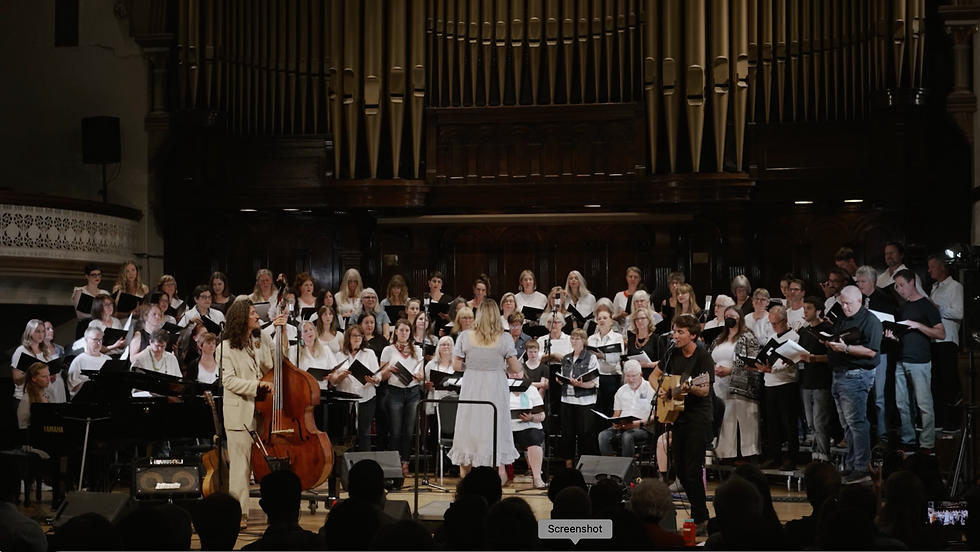
“Tell me all about it!”
He sings and chants in absolute empathy with all of us.
“I want it Louder!”
He exalts as he commands in a cycling climax of the song by the same name.
In We Could Make a Comeback, Luke expresses how: “I could tell your son that/ I gave all I had to give.” Significantly, Luke is not saying that he can tell his son he gave all he had to give as is the convention of the North American nuclear family, which began in the 1950s with the onset of consumer culture where commodities, those “precious little things we don’t need,” took the place of spirituality, our connection to the earth and caring beyond ourselves and our immediate families. No. He can tell your son. Luke’s music guides us all in telling not just our sons but someone else’s too, so that we can tell each other that we lived lives of integrity, acting and singing what we know is the right thing to do by embracing “another side of knowing” where we can transform back into community — where we could make a comeback.
Luke confides, like so many of us:
“The truth is that I don’t know where to begin/ In the ocean, the forest, the political grin/ The methane, the coup, the violence within.” Yet, in the same song, as the cadences and candour have transported us along with him, Luke proclaims: “I hear the future going like this/ sound of the singers comin’ through crisp” and as we keep fighting as the forests burn, and the ancient trees fall, young people sit high up in the canopy risking it all to defend the last of the big trees while communing with undiscovered species or chain themselves to gates blocking our access to the land we are all of, we leave Luke’s concerts humming a Beautiful Revolution that will become louder and louder as we all sing, and be, together. As we listen to his music, we feel a good friend in Luke Wallace because, by singing his vulnerability, by sharing himself so fully, he shows us ourselves so we can, in his words: “Build a bigger wolfpack/ And get ‘em howling at the wind,” defiant despite all to build something much better, “back to the soil/ back to the sand/ back to ourselves.”
And the moment’s arrived. Nah-Nah …
Listen, we're all on the
Same Side
About the Artists:
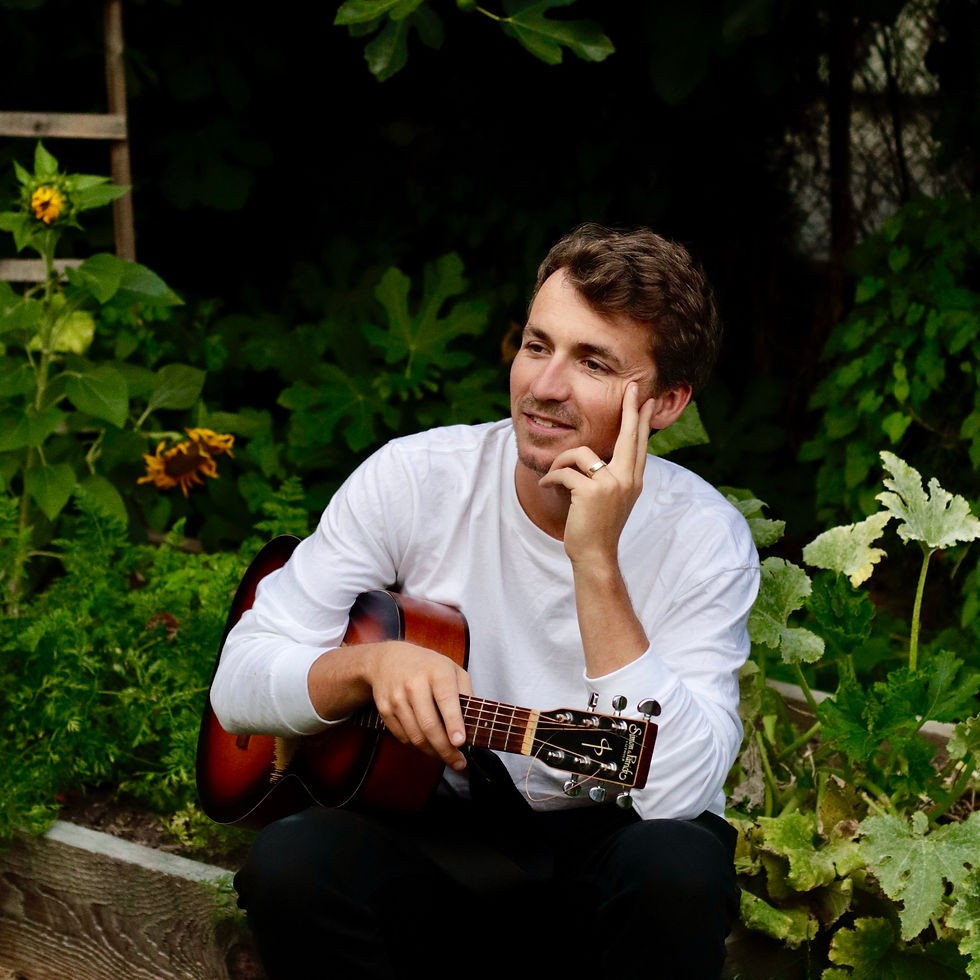
Luke Wallace is a Vancouver born songwriter whose deep commitment to justice and the earth permeates everything he does. Using his talent as a performer, speaker, and choral collaborator he champions environmental causes and builds community wherever he goes. Now 33, Luke’s humble beginnings of frontline activism and community fundraising have bloomed into an international touring career that has him playing festivals and conferences in the UK, Germany, USA, India and Canada.
Luke's unique brand of politically charged folk has earned him a loyal following and a reputation as a modern-day Pete Seeger. From festivals to rallies to venues, Luke's music is a rallying cry for a movement of people rising up to meet the social and environmental challenges of our time. With his latest singles “Be the Arc” and “Same Side” Luke continues to push the boundaries of folk music and prove that art can be a powerful tool for change.
Karen Moe is an author, art critic, visual and performance artist, and feminist activist. Her art criticism has been published internationally in magazines, anthologies and artist catalogues in English and Spanish and she has exhibited and performed across Canada, the US and Mexico.
Karen is the author of Victim: A Feminist Manifesto from a Fierce Survivor. She speaks internationally on sexual violence, sharing her lived experiences of trauma & triumph. She is the founder and editor of Vigilance Magazine and Victim has recently been translated into Spanish and is being adapted for film. Her most recent publication in collaboration with Elder Bill Jones is Listening Once Again to Our Great Mother: The Fairy Creek Blockades and the Life Story of Pacheedaht Elder Bill Jones. Karen lives in Mexico City and Lantzville BC where she is committed to her life as, in Elder Bill’s words: “A most effective truth-seeker."


Comments